
Contents
JustWolves is an educational platform and is not a SEBI-registered investment advisor. Trading financial instruments involves significant risk of loss and may not be suitable for all investors. Past performance is not indicative of future results. Read our full disclaimer →
What is Order Block?
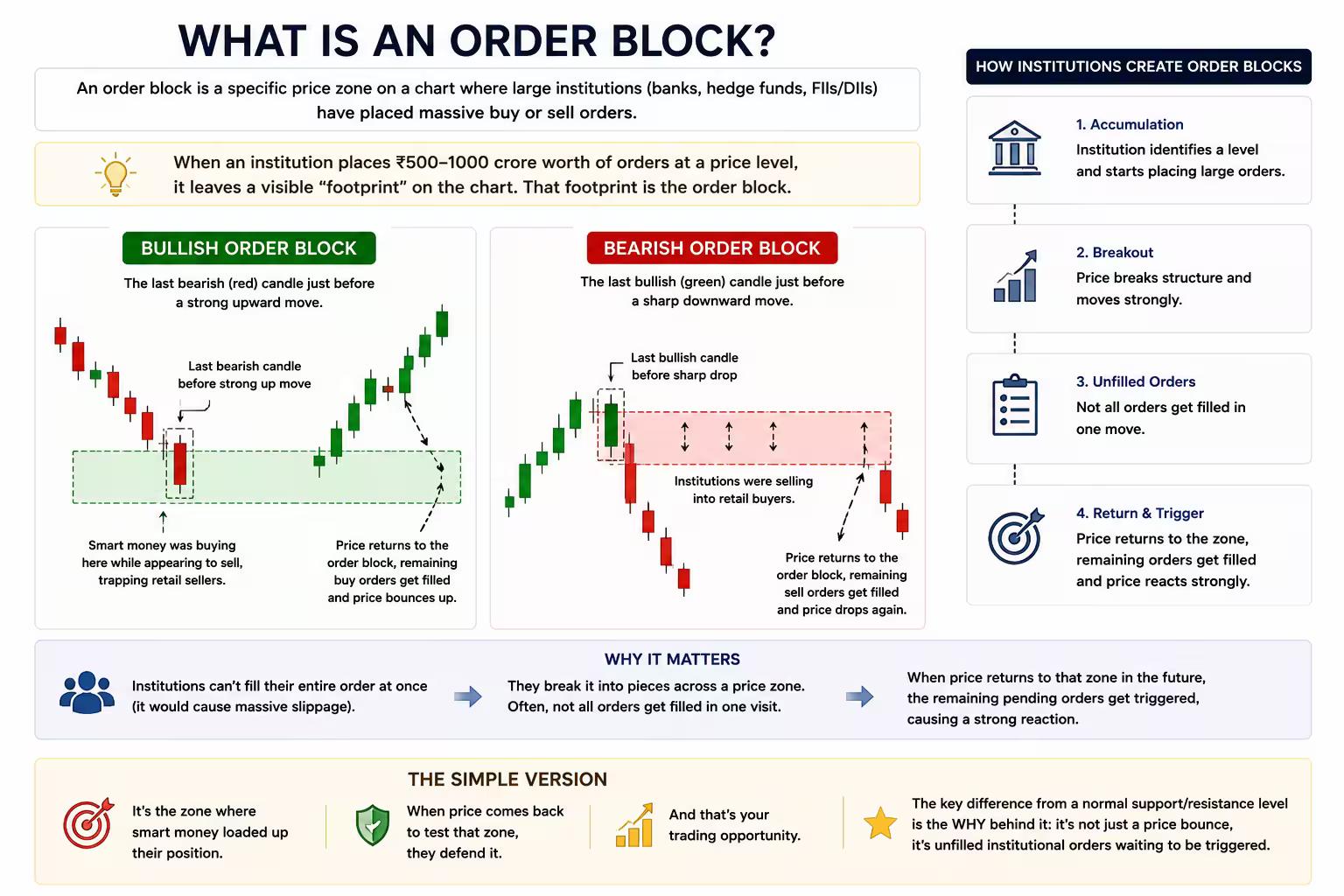
An Order Block (OB) is a price zone where institutions such as banks, hedge funds, and large market participants place significant buy or sell orders.
Unlike retail traders, institutions cannot simply execute massive positions with one click.
For example:
Imagine a hedge fund wants to buy 500,000 contracts.
If they place the entire order at market price, demand immediately pushes price higher, forcing them to buy at increasingly worse prices.
To avoid this, institutions:
- Split orders into smaller pieces
- Place them across a price zone
- Leave pending orders behind
- Revisit those zones later to complete execution
This institutional activity creates order blocks.
When price returns to these zones, the remaining orders often trigger strong reactions.
Why your stop-loss keeps getting hunted
You've done everything right. Your support and resistance levels are clean, your direction is correct — but the moment you enter, price sweeps your stop-loss and then rockets in your direction. Professionals call this a liquidity grab.
"The uncomfortable truth: When you spot a double top and sell, smart money already knows your stop-loss is sitting just above that high. Your stop-loss is their trade entry point.
❝Institutions — the FIIs, DIIs, and hedge funds moving hundreds of crores at a time — cannot simply press "buy" at any level. Dumping ₹500 crore into a single level would cause massive slippage, moving their average entry price far from their target. Instead, they engineer the conditions to collect your orders quietly.
How institutions actually enter the market
How institutions actually enter the market
- 1
Step 1 — Create panic & lay the trap
Institutions deliberately sell near a support area to make the chart look bearish. Support breaks, retail traders exit their longs in fear — generating the sell orders that institutions need as buying liquidity.
- 2
Step 2 — Absorb the falling price
As retail traders pile into sells, smart money quietly places large buy limit orders in that exact zone, absorbing the falling price. This is where the order block is formed.
- 3
Step 3 — Release the price
Once their accumulation is complete and retail sellers are exhausted, institutions step back. Demand overwhelms supply and price rockets upward, leaving those distinctive big bullish candles on your chart.
The 3 rules of a valid order block
The 3 rules of a valid order block
- 1
Rule 1
Price imbalance (Fair Value Gap): After the order block candle, there must be an aggressive displacement where candle 1's high/low and candle 3's low/high don't overlap. This gap — an inefficiency — shows institutional volume was so one-sided that price couldn't trade fairly. The market will return to fill it.
- 2
Rule 2
Liquidity sweep: The order block candle must have first swept the highs or lows of surrounding candles (a stop hunt). This swept liquidity is the fuel institutions needed to fill their enormous orders. An order block with a confirmed sweep has a significantly higher success rate than one that merely broke structure.
- 3
Rule 3
Unmitigated zone: After forming, price must not have returned to and touched that zone. Once price revisits and trades through an order block, the pending institutional orders there are filled — the zone is dead. Always trade only fresh, untested zones.
Checklist for a High-Probability Order Block
Before marking an order block, ask yourself:
1. Did It Sweep Liquidity?
✔ Yes
2. Is There an FVG or Imbalance?
✔ Yes
3. Has the Zone Remained Unmitigated?
✔ Yes
4. Is There a Valid BOS and Inducement?
✔ Yes
If all four conditions are met, you likely have a high-probability institutional order block.
Executing the trade — 3 entry models
Proximal limit entry
Proximal limit entry
Place a limit order at the very edge of the order block zone. No screen time needed — emotions stay out of the picture and missing the entry is nearly impossible.
Lower timeframe confirmation
When price enters your 1H zone, drop to 5m or 1m and wait for an internal Change of Character — a bearish-to-bullish structural shift. Tightest stop-loss, best risk-reward.
Equilibrium (50%) entry
Mark the midpoint of a large order block candle and place your limit there. Institutional algorithms frequently react from exactly the 50% level — reduces stop-loss size significantly.
Up Next
How to Read Liquidity: Sweep vs. Run Explained