
Key Takeaways
Contents
JustWolves is an educational platform and is not a SEBI-registered investment advisor. Trading financial instruments involves significant risk of loss and may not be suitable for all investors. Past performance is not indicative of future results. Read our full disclaimer →
❝Trading the wrong currency pair at the wrong time is one of the most common and costly mistakes in forex. Understanding what a currency pair is, which session it belongs to, and how price behaves in that session is not optional knowledge — it is the foundation that every trade decision is built on.
Part 1: Understanding Currency Pairs
In forex, you never trade a single currency in isolation. You always trade one currency against another. Think of it like going to a supermarket — you cannot just say "I want to buy some euros." The other party will ask: what are you giving me in exchange? That exchange relationship is what a currency pair represents.
A currency pair measures the value of one currency relative to another. When you buy EUR/USD, you are simultaneously buying the euro and selling the US dollar. When you buy USD/JPY, you are buying the US dollar and selling the Japanese yen.
Two Decisions, One Trade
You are always making two decisions at once in forex. Buying EUR/USD means you are bullish on the euro AND bearish on the US dollar at the same time.
Base Currency and Quote Currency
Every currency pair has two parts. The base currency is the first currency listed in the pair. The quote currency is the second currency listed. In EUR/USD, the euro is the base and the US dollar is the quote.
The price of a currency pair tells you how much of the quote currency it costs to buy one unit of the base currency. If EUR/USD is at 1.3500, it costs $1.35 USD to buy one euro. If you went to a money changer and said "I want to buy one euro," they would say: "Give me $1.35 and I will give you one euro." That is exactly how the price of a currency pair works.
Base and Quote — The Two Rules
Three Types of Currency Pairs
Major pairs
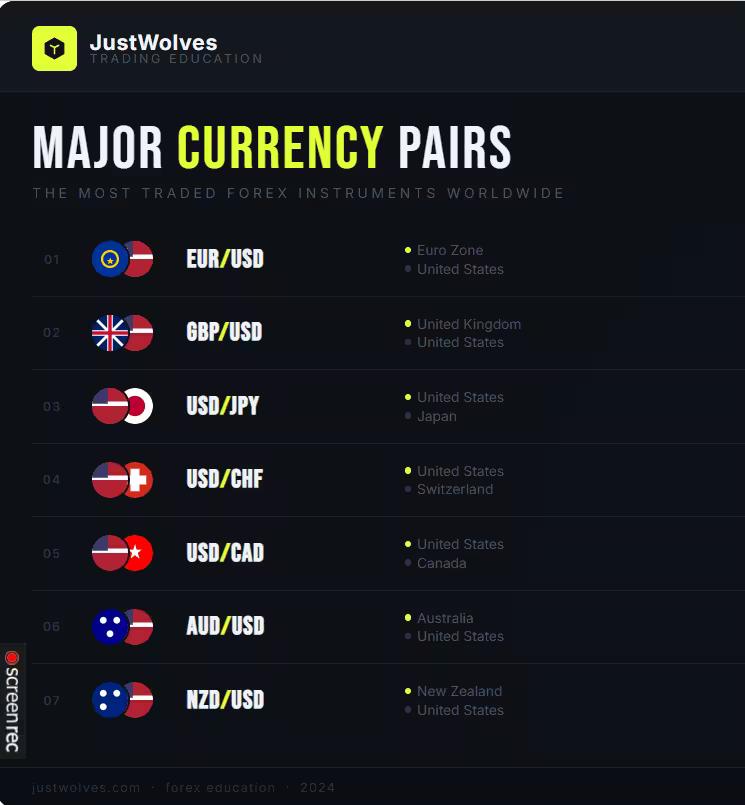
Major pairs are the seven most traded currency pairs in the world. They all include the US dollar as either the base or quote currency. Examples include EUR/USD, GBP/USD, USD/JPY, USD/CAD, AUD/USD, NZD/USD, and USD/CHF.
Majors are the best starting point for beginners. They have the tightest spreads — meaning lower transaction costs — and the least slippage because they are the most liquid markets in the world. If you are new to forex, start with one or two major pairs before branching out.
Cross pairs
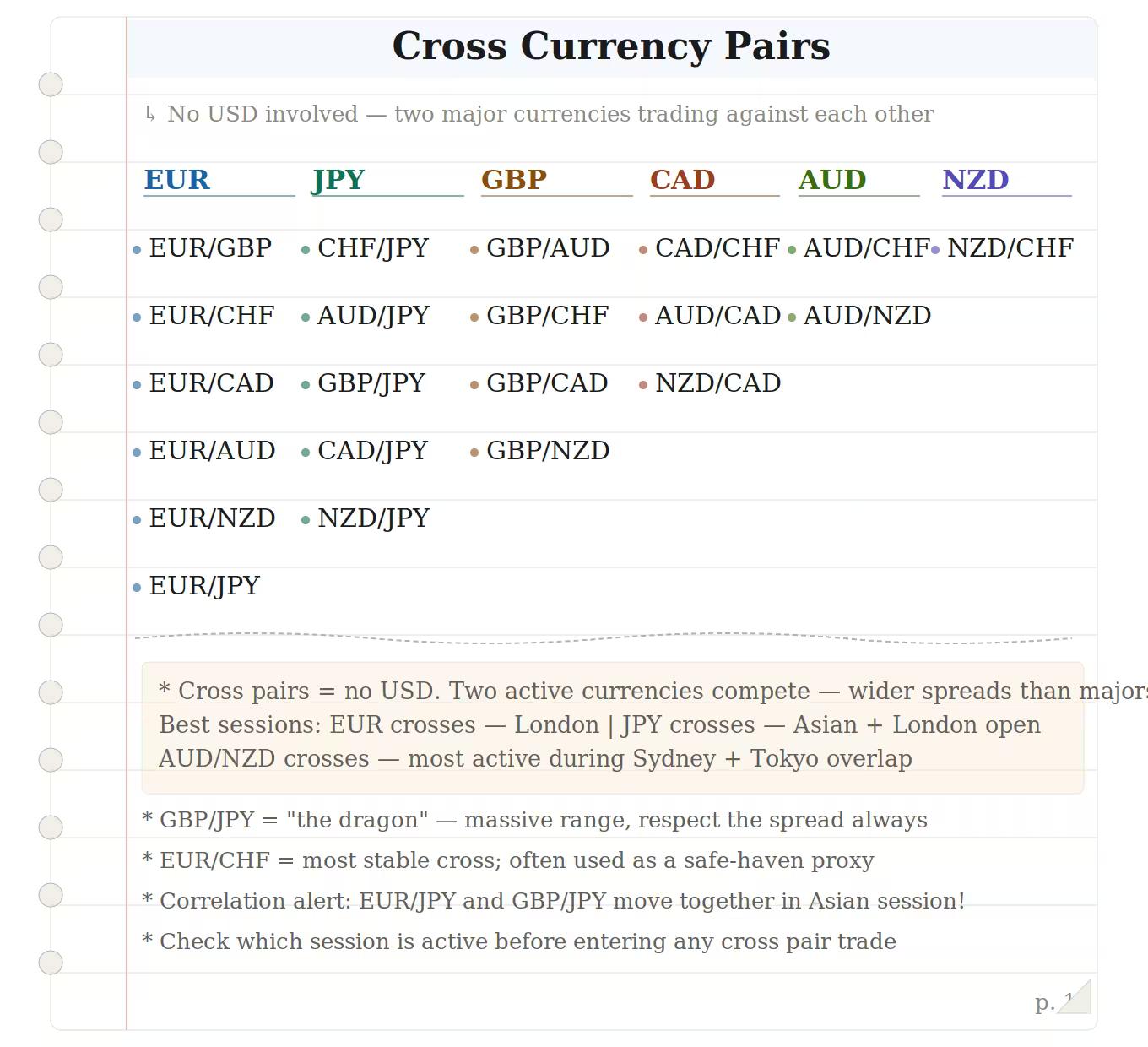
Cross pairs, also called crosses, are currency pairs that do not include the US dollar. They are formed by pairing two major currencies against each other. Euro crosses include EUR/GBP, EUR/AUD, and EUR/NZD. Pound crosses include GBP/JPY, GBP/AUD, and GBP/NZD.
Crosses can be more volatile than majors because they are indirectly driven by two separate USD relationships. GBP/JPY, for example, is essentially the ratio of GBP/USD divided by USD/JPY — so it amplifies the moves of both.
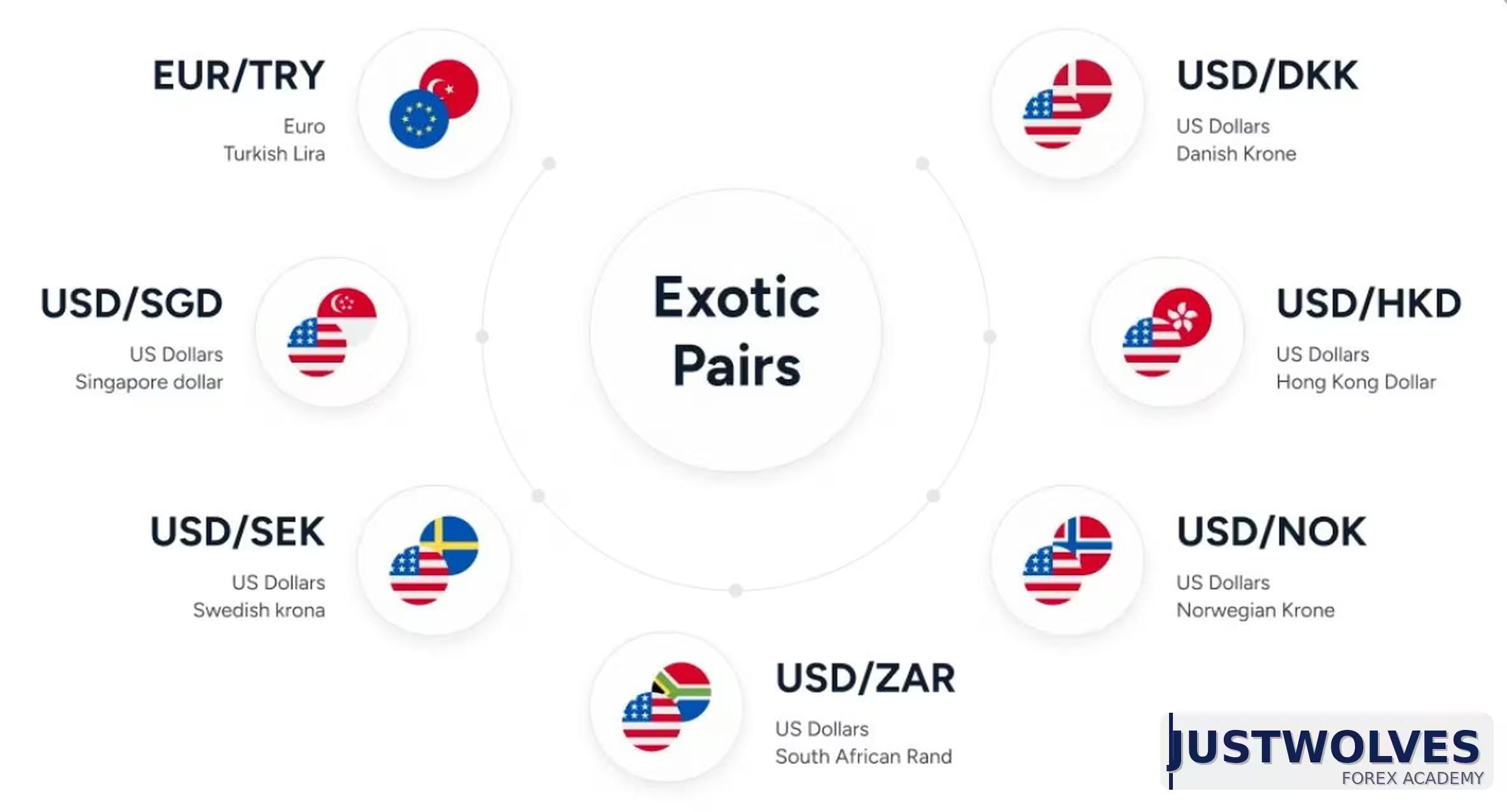
Exotic pairs
Exotic pairs combine one major currency with the currency of a developing or emerging-market economy. Examples include USD/MXN (US dollar vs Mexican peso), EUR/TRY (euro vs Turkish lira), and GBP/INR (British pound vs Indian rupee).
Exotic pairs have significantly wider spreads and higher transaction costs. They are less liquid and can gap sharply on political or economic news. Beginners should avoid exotic pairs until they have solid experience with majors.
Start With Majors
For beginners: trade major pairs only. Lower spreads, more liquidity, and cleaner price action mean fewer surprises and lower costs on every trade.
Part 2: Trading Sessions Explained
The forex market runs 24 hours a day, five days a week — but not all hours are equal. The market is divided into three major sessions: Asian, London, and New York. Each session has distinct characteristics in terms of volume, the currencies that dominate price movement, and how price behaves. Trading the wrong pair in the wrong session is one of the most common reasons traders experience confusing and unpredictable price action.
Sessions overlap at certain times, creating windows of extremely high volume. The most active period of the entire trading day is the London-New York overlap — roughly 1:00 PM to 5:00 PM GMT — when both the world's largest financial centres are simultaneously open.
Mark Sessions on Your Chart
On TradingView, search for the "Market Sessions" indicator by Leviathan. It automatically marks all three sessions on your chart with customisable colours, so you always know which session you are in at a glance.
Asian Session
The Asian session is the quietest of the three. Major financial centres like London and New York are closed, so overall trading volume is low. Price tends to consolidate — moving sideways or in narrow ranges — rather than trending strongly. Candles are typically smaller with shorter wicks, reflecting limited price movement.
The currencies most actively traded during the Asian session are the Japanese yen, Australian dollar, and New Zealand dollar. If you want to trade in the Asian session, focus on pairs that include at least one of these currencies — USD/JPY, AUD/USD, or NZD/USD, for example.
The Asian session serves an important structural purpose even for traders who do not trade it directly: it builds the range that the London session will often break out of. The highs and lows set during the Asian session frequently become the key levels that London uses as its directional catalyst.
London Session
The London session is the most important session for forex traders. It accounts for approximately 40% of total daily forex trading volume — more than any other single session. When London opens, the market typically transitions from the quiet Asian consolidation into strong directional moves with clear trends.
The most actively traded currencies in this session are the British pound, euro, and Swiss franc. Price action in EUR/USD, GBP/USD, EUR/GBP, and related pairs is primarily driven by this session. The London open frequently produces breakouts from the Asian range, setting the directional bias for the rest of the trading day.
For pairs to move well in the London session, you need one currency to be actively traded while the other is relatively passive. EUR/JPY works well during London because the euro is in full swing while the Japanese yen is winding down from the Asian session — the euro drives the pair and you get clean, trending moves.
New York Session
The New York session is characterised by high liquidity and significant volatility, particularly in pairs involving the US dollar. The session opens with the London-New York overlap — the most active period in the entire forex market — where both sessions are simultaneously running. This overlap produces some of the largest candles and strongest trends of the day.
A critical factor in the New York session is the economic news calendar. Major US reports — inflation data (CPI), Federal Reserve interest rate decisions, GDP reports, and Non-Farm Payrolls — are typically released at or just before the New York open. These events can override all technical analysis, causing sudden sharp spikes, fake-outs, and reversals that have nothing to do with the chart structure.
Always check the economic calendar before trading in the New York session. High-impact news events (marked with three stars on Fastbull.com or any other calendar) require either widening your stop-loss significantly or stepping aside entirely until the initial volatility settles.
High-Impact News Risk
Three-star news events — especially US CPI, Fed rate decisions, and Non-Farm Payrolls — can move markets 100+ pips in seconds. Never hold a trade through a three-star event without a significantly wider stop or a clear plan.
Actively Traded Currencies by Session
The single most important factor for selecting which pair to trade is whether the currencies in that pair are actively traded in the session you are in. A pair moves because one or both of its currencies are being actively bought or sold. If neither currency is active in the current session, the pair will do nothing — or worse, move randomly.
Dominant Currencies by Session
JPY · AUD · NZD
Asian Session
EUR · GBP · CHF
London Session
USD · CAD · EUR
New York Session
The most important rule for pair selection follows directly from this: choose pairs where one currency is the dominant, actively-traded currency of the session and the other currency belongs to a closed session. This creates a single driver — one currency pulls the pair in a clear direction without interference from the other.
EUR/JPY during London is a textbook example. The euro is the dominant London currency; the yen is finishing its Asian session and becoming less active. The euro drives the pair and you get clear, directional movement. Compare this to AUD/JPY during the Asian session — both the Aussie and the yen are active, creating a tug-of-war that produces messy, unpredictable price action.
Price Action Patterns by Session
Each session produces recurring price action patterns that you can use as part of your trading framework. These are not guaranteed — nothing in trading is — but they happen frequently enough to be worth planning around.
Session Price Action Tendencies
Pair Correlation and Session Mistakes
Currency pair correlation is one of the most misunderstood concepts in forex — and getting it wrong can silently double your risk or guarantee a losing trade.
Correlation describes how two pairs move in relation to each other. Some pairs move in the same direction at the same time; others move in opposite directions. During the Asian session, EUR/JPY and GBP/JPY are highly correlated because the yen is the only active currency in both pairs. Both pairs are driven by yen strength or weakness — so they move together. If you hold a long EUR/JPY and a long GBP/JPY position simultaneously, you have not diversified — you have doubled your yen exposure.
A classic example of a session mistake: buying GBP/JPY and selling EUR/JPY at the same time during the Asian session. Both pairs are driven by the same yen movement. One of those trades is almost guaranteed to hit its stop-loss while the other wins — you have effectively entered a zero-sum trade against yourself. The lesson: when pairs share the same dominant currency in a given session, trading them in opposite directions cancels out, and trading them in the same direction doubles your risk without doubling your edge.
"Buying GBP/JPY and selling EUR/JPY in the Asian session is not two trades. It is one trade against yourself — the yen drives both.
Correlation Risk Check
Before entering multiple positions simultaneously, check whether they share a dominant currency in the current session. If they do, you are not diversified — you are multiplying exposure to a single currency move.
The most effective approach to trading gold is trend-following combined with Fibonacci retracements to time entries precisely. The two key levels are the 61.8% and 78.6% retracement levels.
In an uptrend, gold will frequently retrace deeply — sometimes all the way to the 78.6% level — before resuming higher. These deep retracements are not reversals; they are the market shaking out weak hands before the trend continues. Buying at the 78.6% retracement with the trend gives you a high risk-to-reward ratio: your stop-loss sits just below the swing low, and your target is the next key level or the previous high.
In a downtrend, the same logic applies in reverse. When gold retraces to 61.8% or 78.6% of a bearish impulse leg, look for signs of continuation — a bearish rejection candle, a failure to close above the level — before entering short.
check our forex market hours tools here.
Why These Levels Work
Gold's deep retracements to 61.8% and 78.6% Fibonacci levels are a feature, not a bug. These levels exist because institutions use them to accumulate positions before continuing the trend. Trading with this flow — not against it — is the edge.
"A losing trade executed with discipline is better than a winning trade taken recklessly. The process matters more than any individual outcome.
Frequently Asked Questions
Why do currencies trade in pairs and not individually?
Because currency value is always relative, never absolute. A euro has no fixed value by itself — it is only worth something in relation to another currency. When you buy euros, you are exchanging something else (usually dollars) to get them. The pair format reflects this exchange relationship and tells you the price of one currency in terms of another.
Which currency pairs are best for beginners?
Start with major pairs — EUR/USD, GBP/USD, or USD/JPY. They have the tightest spreads, highest liquidity, and clearest price action. EUR/USD is the most traded pair in the world and has the most consistent, well-documented behaviour. Once you are consistently profitable on one major pair, expand to others.
Why does the session matter so much for which pair I trade?
Price moves when the currencies in a pair are being actively bought and sold. If both currencies in a pair belong to closed sessions, there is no institutional volume to drive movement — price drifts randomly. Trading EUR/USD during the Asian session, for example, is like fishing in a dry pond: the major participants are not there yet. Wait for London to open for clean EUR/USD movement.
What is the London–New York overlap and why is it important?
The London–New York overlap occurs roughly between 1:00 PM and 5:00 PM GMT, when both the world's largest forex trading centres are simultaneously active. This window has the highest volume, the largest candles, and the strongest trends of the entire trading day. It is the best time to trade USD pairs, EUR pairs, and GBP pairs if you are looking for fast, directional moves.
Why use the 78.6% Fibonacci level specifically for gold?
Gold is known for deep retracements before continuing its trend. Shallow retracement levels like 38.2% or 50% are frequently not enough to complete gold's pullback before the trend resumes. The 61.8% and 78.6% levels capture the deeper retracement zones where institutional buyers or sellers step in to continue the trend, giving you a high-probability entry with a tighter stop relative to the potential move.
What should I do if a trade hits stop-loss after a breakout confirmation?
Accept it as a cost of the strategy. Failed breakouts happen regularly — a 4-hour candle can close above a level, triggering a breakout confirmation, and then reverse. This is why key levels are zones rather than exact lines. A failed trade executed correctly is not a mistake. The mistake would be moving your stop-loss, over-sizing after a loss, or abandoning the strategy after one losing trade. Consistent execution over many trades is where the edge shows up.
Up Next
Break of Structure and change of character BOS vs CHOCH