
Key Takeaways
Contents
JustWolves is an educational platform and is not a SEBI-registered investment advisor. Trading financial instruments involves significant risk of loss and may not be suitable for all investors. Past performance is not indicative of future results. Read our full disclaimer →
The Anatomy of a Candle
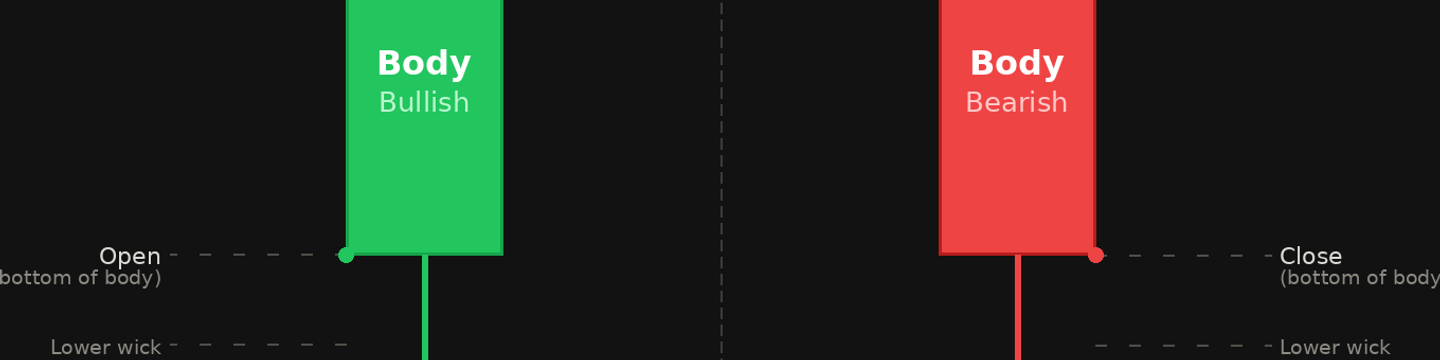
Every candlestick tells a complete price story for a selected time period — whether it's 1 minute or 1 day. To read that story, you must first know its parts.
Parts of a Candlestick
| Part | Meaning | Pysocology |
|---|---|---|
| Open | The first traded price of that candle | The emotional starting point — where the battle begins |
| Close | The final traded price | The result — who won (bulls or bears) |
| High | The highest price during that period | The strongest push by buyers |
| Low | The lowest price during that period | The deepest attempt by sellers |
| Body | Difference between Open and Close | Strength of control — long body = strong momentum |
| Wicks / Shadows | Lines above & below the body | Rejections — areas where price was pushed back by the opposite force |
Shadows & Wicks — Where the Truth Hides
Wicks — also called shadows — are the thin lines above and below a candle's body. Most beginners ignore them. Professional traders live by them.
A candle may look bearish at first glance, but a long lower wick tells a different story: buyers stepped in aggressively and rejected lower prices. That single detail can be the difference between a losing trade and a winning one.
Understanding Wick Types
| Wick Type | Interpretation | Market Emotion | |
|---|---|---|---|
| Bullish | Long Upper Wick | Sellers rejected higher prices | Profit booking / resistance pressure |
| Bearish | Long Lower Wick | Buyers rejected lower prices | Support / rebound pressure |
| Neutral | Small Wicks | Stable, balanced market | Neutral momentum |
| Strong | No Wick (Marubozu) | One-sided price control | Strong conviction — no rejection |
Related in price action
Keep building your knowledge
Up Next
Japanese Candlesticks: The Complete Guide from A to Z