
Ford Motor trades at the price of two Big Macs. Berkshire Hathaway costs more than most people's houses. Does that make Ford cheap and Berkshire expensive? No — and understanding why is the entire foundation of stock valuation. Price is what you pay; value is what you get. This guide walks through three proven methods for determining whether a stock is genuinely cheap or genuinely expensive before you commit a single rupee or dollar.
Why Stock Price Alone Tells You Nothing
A new Ferrari priced at $100,000 might be a bargain. A broken bicycle at $50 is expensive. The number on a price tag only becomes meaningful when compared to what you receive in return. The same logic applies to every stock in the market.
Warren Buffett captures it simply: price is what you pay, value is what you get. The entire discipline of stock valuation is the attempt to measure that gap — to determine whether the value a business will deliver over time exceeds, matches, or falls short of what the market charges today.
Investors use many yardsticks to estimate value. The most common is earnings. Just as a student evaluating a $200,000 degree calculates how many years of extra salary will pay it back, a stock investor asks how quickly a company's earnings will repay the purchase price. That ratio is the foundation of relative valuation.
The Fundamental Principle
"Price is what you pay. Value is what you get." — Warren Buffett. The gap between those two figures is where investment returns come from.
Valuation Multiples: The Right Yardstick
The most widely used valuation multiple is the price-to-earnings ratio — the P/E ratio. It measures how many years of current earnings you are paying for when you buy the stock today.
At a price of $72 per share and earnings of $2.50 per share, Coca-Cola's P/E is 72 ÷ 2.50 = 28.8. An investor is paying 28.8 years of current annual earnings upfront. On its own, this number is neither cheap nor expensive — it only becomes meaningful in comparison.
That comparison is the core of relative valuation: compare the current P/E to the company's own historical average and to the P/E of comparable companies in the same industry. This two-part check tells you whether the market is pricing the stock above or below what has historically been fair value.
Trailing P/E vs Forward P/E
The standard P/E ratio uses the last twelve months of actual reported earnings — the trailing P/E. It describes the past, and as Buffett notes, you cannot pay bills with past performance.
The forward P/E divides the current price by analysts' consensus estimate for next year's earnings. For Coca-Cola, with earnings expected to grow, the forward P/E is lower than the trailing P/E — approximately 24.3 times. Forward P/E gives a better sense of what you are actually paying for, though it introduces forecast uncertainty.
For stable, slow-changing businesses, forward P/E is the more useful starting point. For cyclical or high-growth companies where analyst estimates are unreliable, trailing P/E or other multiples may be more robust.
✦ Coca-Cola Valuation Snapshot
$72
Current share price (example)
28.8×
Trailing P/E — price ÷ last 12 months EPS of $2.50
24.3×
Forward P/E — price ÷ next-year analyst EPS estimate
23×
10-year historical median forward P/E for Coca-Cola
21.3×
Carbonated beverage peer group average forward P/E
Historical Averages and Peer Comparison
Two benchmarks make the P/E ratio actionable: the company's own long-run average and the valuation of its direct competitors.
For Coca-Cola over the past ten years, investors have typically paid around 23 times forward earnings. That is the historical anchor. A current forward P/E of 24.3 times sits above that anchor — the market is pricing Cola slightly more expensively than usual, suggesting limited upside unless earnings grow faster than expected.
Peer comparison extends the analysis further. Carbonated beverage competitors — PepsiCo, Dr Pepper, Monster, and the Scottish company AG Bar — trade at an average forward P/E of 21.3 times. At 24.3 times, Coca-Cola carries a premium over its peers. Were it repriced to match the peer average, the stock would fall approximately 12%.
The peer comparison can also surface better opportunities within the same industry. AG Bar, for example, trades at a discount both to its own historical average and to the peer group median. If AG Bar reaches its historical valuation, it offers 18% upside. If it reaches the peer group average, the upside grows to 33%. The same research that benchmarks one stock frequently illuminates a more attractive alternative nearby.
The Two-Benchmark Rule
Compare any stock to two things: (1) its own 5–10 year median P/E and (2) the current median P/E of its closest competitors. A stock cheap on both measures is a much stronger relative value candidate than one that is cheap on only one.
The Margin of Safety: The Three Most Important Words in Investing
Benjamin Graham — Warren Buffett's mentor — introduced the margin of safety. The idea is straightforward: never buy a stock when its price equals your estimate of its intrinsic value. Buy only when there is a meaningful gap between what you pay and what the business is genuinely worth.
Seth Klarman, one of Graham's most successful students, explained why: "A margin of safety is necessary because valuation is an imprecise art, the future is unpredictable, and investors are human and do make mistakes." The margin of safety exists to absorb those inevitable errors.
"We'd love to find them when they're selling at 40 cents on the dollar, but we will buy those at much closer to a dollar on the dollar. We don't like to pay a dollar on the dollar, but we'll pay something close. — Warren Buffett
Buffett's own approach scales the required margin of safety to his confidence in his assumptions. For businesses he understands deeply — Coca-Cola, See's Candy — he does not require a large safety cushion because he trusts his forecasts. For businesses in rapidly changing industries, he simply avoids them rather than compensating with a deeper discount.
In practice: predictable businesses with durable competitive advantages need a 10–20% margin of safety. Uncertain, disruption-prone businesses should be purchased only at a 30–50% discount below intrinsic value — or skipped entirely.
The Limits of Relative Valuation
Relative valuation has a structural flaw: it assumes the comparison benchmarks are themselves rational. If an entire sector is overpriced, finding the "cheapest" stock still means buying an overpriced asset.
During the 2000 dot-com bubble, a software company at 100 times earnings was described as cheap because peers traded at 200 times. Both valuations were irrational. Three years later, the "cheap" stock had lost 90% of its value alongside the rest of the sector.
Relative valuation is a necessary first filter — it quickly identifies candidates that warrant deeper analysis. But it cannot stand alone. The next step is absolute valuation: determining what the business is actually worth in cash terms, independent of what the market is currently paying for anything in its category.
The Relative Valuation Trap
Relative valuation tells you if a stock is cheap compared to the market — not whether the market itself is rational. Always cross-check relative valuation conclusions with at least one absolute valuation method.
DCF Analysis: Buffett's Three Questions
Warren Buffett's preferred valuation framework asks three questions about any investment: How much cash will I get? When will I get it? How certain am I?
These three questions form the basis of a discounted cash flow (DCF) analysis. In Buffett's words, "just insert the correct numbers and you can rank the attractiveness of all possible uses of capital throughout the universe." A DCF can value a stock, a private business, a rental property, a bond, or a lemonade stand. The logic is universal: the value of any investment today is the sum of all future cash it will generate, adjusted to reflect the time value of money.
Step 1: Free Cash Flow — How Much Cash Will You Get?
The DCF model uses free cash flow (FCF) rather than earnings. Free cash flow is the cash generated after funding all the investment needed to sustain and grow the business. The formula: FCF = Operating Cash Flow − Capital Expenditures.
Free cash flow is closer to the actual money available to shareholders than reported earnings, because it accounts for the real capital spending required to run the business. A company with strong earnings but heavy capital reinvestment requirements may produce far less actual cash than its income statement suggests.
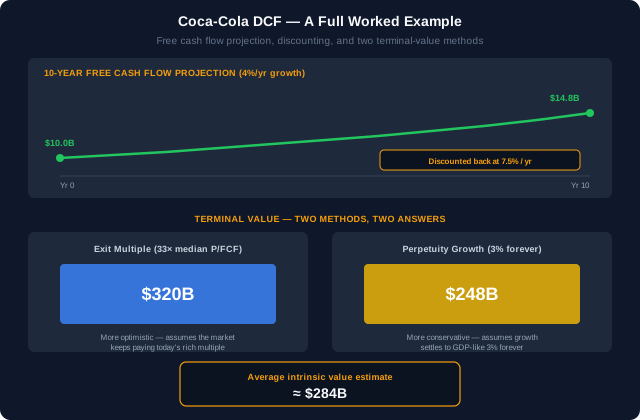
To forecast future FCF, start with the historical record. For Coca-Cola, roughly $10 billion per year is a reasonable baseline under normal conditions. The growth rate applied should reflect both the company's own historical FCF growth and the expected expansion of its industry. For Cola: historical FCF growth since 2019 is approximately 3.5% per year, and the global carbonated beverage industry is projected to grow at 6.4% per year through 2030. A 4% annual growth rate for the forecast is reasonable, yielding projected year-ten FCF of approximately $14.8 billion.
Avoid Growth Rate Optimism
Growth rate sanity check: if you are modelling 15% annual growth for a large established company, ask whether the entire economy could sustain 15% growth. Very few large businesses can compound cash flows at that rate. Buffett's rule: "It just doesn't make sense for most large companies."
Step 2: The Discount Rate — When Will You Get It?
Money received today is worth more than money received next year. A 10% discount rate means you value next year's $100 as $90.91 today — because $90.91 invested now at 10% returns exactly $100 in one year. This time preference is what the discount rate captures.
Buffett's guidance, drawn from recorded shareholder meetings, is consistent: start with the current long-term government bond yield as the risk-free base and add a premium to reflect the extra risk of owning a business. At a 1994 meeting with bond yields at 7%, he specified a discount rate of at least 10% — approximately 300 basis points above the risk-free rate.
At a 2007 meeting, with bonds at 4.9% (almost exactly where they sit today at 4.5%), he said he wants a "fair amount more" than the risk-free rate — enough that a further 100–200 basis point rate rise would still leave him comfortable with what he bought.
✦ Buffett's Discount Rate Framework
Treasury + ~3%
Practical approximation of Buffett's discount rate — adjusts automatically as interest rates change
7.5% (example)
At current US 10-year yield of ~4.5%: 4.5% + 3% = 7.5% discount rate for a stable business like Coca-Cola
Step 3: Business Certainty — How Sure Are You?
The third question is the qualitative filter. Buffett judges certainty by the historical reliability of the business and its resistance to competitive disruption.
Coca-Cola has sold a nearly identical product for over 110 years. The fundamentals of distribution, consumer preference, and brand loyalty have changed little in a century. An analysis written 50 years ago would still be largely applicable today. This is what Buffett seeks — not perfect prediction, but the recognition that certain businesses are genuinely predictable over long time horizons.
Technology hardware, cyclical industrials, and businesses facing structural disruption carry far less certainty. For these, the forecast cash flows in a DCF are speculative, and the margin of safety required to justify an investment must be proportionally larger.
"We are looking for businesses that are not going to be susceptible to very much change. We view change as more of a threat than an opportunity. — Warren Buffett
Terminal Value: Exit Multiple vs Perpetuity Growth
A standard DCF forecasts detailed cash flows for years one through ten, then adds a terminal value — a single number representing all cash flows from year eleven onward. This is necessary because business value extends far beyond any ten-year window.
The exit multiple method asks: if the business were sold at the end of year ten, what multiple of that year's FCF would a buyer pay? For Coca-Cola, the historical median price-to-FCF multiple is approximately 33 times. Applying this to projected year-ten FCF of $14.8 billion gives a terminal value of $488 billion.
The perpetuity growth method asks: what if the business continues growing at a modest rate forever? The formula: Terminal Value = FCF in year eleven ÷ (discount rate − perpetual growth rate). For Coca-Cola with 3% perpetual growth and a 7.5% discount rate, this produces a much lower terminal value — and a total DCF valuation of approximately $248 billion versus $320 billion using the exit multiple.
Neither method is definitively correct. Averaging both provides a more balanced estimate. When neither produces a compelling buy at a meaningful margin of safety, the conclusion is clear: the stock is not an obvious bargain at today's price.
Terminal Value Trap: Growth ≥ Discount Rate
If your perpetual growth rate approaches or exceeds your discount rate, the perpetuity growth formula breaks down mathematically. This is usually a signal that the growth assumption is too aggressive for a perpetuity — switch to the exit multiple, or reduce the growth rate significantly.
Coca-Cola DCF: A Full Worked Example
Combining all the inputs discussed above, here is a summary of the Coca-Cola DCF at current prices.
✦ Coca-Cola DCF Key Inputs
$10B
Estimated baseline free cash flow (current year)
4%
Annual FCF growth rate applied over years 1–10
$14.8B
Projected free cash flow in year 10
7.5%
Discount rate (US 10-year yield + 3%)
33×
Exit multiple — historical median price-to-FCF
3%
Perpetual growth rate used in terminal value
Using the exit multiple method, the DCF values Coca-Cola at approximately $320 billion. Using perpetuity growth, the valuation falls to approximately $248 billion. Averaging both methods places intrinsic value at roughly $284 billion. At Coca-Cola's current market capitalisation, this does not represent a compelling buy with a large margin of safety — the stock appears fairly priced at best.
This is not a recommendation to sell or avoid Coca-Cola. It is an illustration of the process. The same framework applied to a stock trading at a significant discount to its DCF-derived intrinsic value would produce a very different conclusion. The method is the tool; the target changes as market prices change.
The Three-Method Stock Valuation Process
Relative Valuation — Is it cheap vs history and peers?
Calculate trailing and forward P/E. Compare to the company's own 5–10 year median and to direct competitors. This takes 15–30 minutes with free tools like Yahoo Finance or Ticker.com. It quickly filters out obviously expensive stocks and surfaces candidates worth deeper analysis.
Margin of Safety — Is the discount large enough?
Calibrate the required discount to the predictability of the business. Predictable moat businesses: 10–20% below intrinsic value may be sufficient. Uncertain, disruption-prone businesses: 30–50% below intrinsic value, or skip them entirely.
DCF Analysis — What is it actually worth in cash terms?
Estimate baseline FCF, apply a realistic growth rate, discount at treasury yield + 3%, calculate terminal value using both methods, and average the results. When relative valuation and DCF both point to a buy at an adequate margin of safety, the investment case is strongest.
Key Takeaways
✦ How to Value a Stock — What to Remember
- Price alone tells you nothing — value is determined by the cash a business will generate relative to the price you pay today
- P/E ratio = price ÷ earnings: tells you how many years of current earnings you are paying for upfront
- Forward P/E uses next-year earnings estimates; more relevant than trailing P/E but dependent on forecast accuracy
- Compare current P/E to two benchmarks: the company's own 5–10 year historical median and the industry peer group average
- Peer comparisons often reveal more attractive investments in the same sector — always scan the full group
- Margin of safety is essential: buy at a meaningful discount to intrinsic value, not at it, because valuation is imprecise
- Required margin of safety scales with uncertainty — predictable businesses need less cushion; uncertain ones need more
- DCF valuation answers three questions: How much cash? When? How certain?
- Free cash flow = operating cash flow minus capex — harder to manipulate and more accurate than earnings for DCF
- Discount rate = 10-year government bond yield + ~3% (Buffett's practical framework)
- Terminal value: use both exit multiple and perpetuity growth, then average — neither alone is definitive
- When neither method produces a meaningful margin of safety, the stock is fairly priced or expensive — wait for a better entry price
Frequently Asked Questions
What is the simplest way to tell if a stock is cheap or expensive?
Compare the forward P/E ratio to two benchmarks: the company's own 5–10 year median forward P/E and the current median forward P/E of its direct competitors. If the stock's current forward P/E sits meaningfully below both benchmarks, it is at a relative discount. If it exceeds both, the market is pricing it expensively by historical and comparative standards. This two-benchmark check is the fastest first-pass filter — but always verify with a DCF before investing.
What is the difference between the P/E ratio and a DCF model?
The P/E ratio is a relative measure — it tells you whether a stock is cheap or expensive compared to other stocks or its own history. A DCF is an absolute measure — it estimates the actual cash value of the business independent of any market comparison. P/E is fast and useful for screening; DCF is slower but provides an independent intrinsic value estimate. The strongest investment cases are those where both methods point to the same conclusion.
What discount rate should I use in a DCF model?
A practical starting point is the current 10-year government bond yield plus approximately 3 percentage points. At a US 10-year yield of 4.5%, that gives a discount rate of 7.5%. This framework automatically adjusts as rates change — higher rates make equities less attractive, lower rates make them more so. For higher-risk or less predictable businesses, add an additional 2–5% risk premium on top.
How large should the margin of safety be?
For highly predictable, competitively protected businesses, Buffett is willing to buy at close to intrinsic value — though he prefers 20–30% below. For businesses in uncertain or rapidly changing industries, a 40–50% discount is more appropriate to compensate for the higher probability of forecast errors. If you cannot find a sufficient margin of safety at current prices, the correct action is simply to wait.
Why use free cash flow instead of earnings in a DCF?
Free cash flow (operating cash flow minus capital expenditures) reflects the cash actually available to shareholders after funding all reinvestment needs. Earnings can be shaped by accounting choices — depreciation methods, revenue recognition, non-cash charges — that diverge from real cash generation. Free cash flow is harder to manipulate and more directly represents what the business is delivering to its owners.
Can the DCF method be used for any stock?
DCF works best for mature businesses with relatively predictable cash flows — consumer staples, utilities, financial services, established industrials. It is less reliable for early-stage companies with no current cash flows, highly cyclical businesses where FCF swings wildly year to year, or companies in industries facing structural disruption where a 10-year forecast is essentially speculation. For those situations, sector-specific multiples, sum-of-the-parts analysis, or simply passing on the investment are more appropriate responses.
Topics